Introduction & Etymology of Dubai

Dubai, located along the coast of the Persian Gulf, stands today as a symbol of architectural innovation, economic prowess, and cultural diversity within the United Arab Emirates. Originally a small fishing settlement, it has grown into a cosmopolitan metropolis home to millions of expatriates from around the world. This transformation from a humble trading village to a global city is tied closely to its strategic location and the visionary leadership of its ruling family. Over the past century, Dubai’s economic policies, infrastructural undertakings, and open embrace of commerce have produced a city that consistently attracts visitors, investors, and entrepreneurs.
The name “Dubai” itself is shrouded in historical intrigue, and its origin is debated among scholars. One widely cited theory suggests that it may derive from the Arabic word “daba,” meaning “to creep,” possibly referencing the slow trickle of the creek inland. Another explanation connects it to the phrase “Daba Dubai,” translating loosely to “They came with a lot of money,” which might reflect the city’s early role as a thriving marketplace. Some historians propose a link to “baby locust” due to the abundance of locusts in the area before modern settlement. Such competing narratives highlight the city’s historical complexity and the difficulty of pinpointing a single, definitive root for its name.
Etymology, the study of word origins, helps illuminate how names evolve alongside cultures and migrations. In the case of Dubai, each theory—whether connected to commerce, geography, or indigenous wildlife—reflects a piece of the city’s rich tapestry. It reminds us that understanding a name can provide insight into a region’s past, revealing something of its environment, economy, or people’s livelihoods. For Dubai, where people of over 200 nationalities now reside, the etymological puzzle aligns perfectly with a place defined by cultural exchange.
As Dubai expanded into a global center of finance, tourism, and entertainment, its very name took on connotations of luxury and ambition. Just as the name’s origins are debated, so too is the city’s identity continuously reshaped by economic shifts and global influences. Today, Dubai’s name conjures images of glittering skyscrapers, world-class hospitality, cutting-edge technology, and an ethos of perpetual reinvention. This evolution from an obscure trading post to a world-renowned metropolis mirrors the city’s historic openness to new ideas and diverse people.
Early Settlement & Historical Foundations

Before the skyscrapers and superhighways, Dubai was once a quiet coastal village inhabited by the Bani Yas tribe in the early 18th century. The community relied heavily on fishing, pearling, and small-scale trading across the Arabian Gulf. Dubai Creek served as the city’s lifeline, allowing fishing boats and pearl divers to anchor and merchants to transport goods. Over time, these modest economic activities laid the foundation for a wider trade network, connecting Dubai to distant markets in the region and beyond.
By the late 19th and early 20th centuries, Dubai’s status as a trade hub drew merchants, migrants, and entrepreneurs. Economic incentives introduced by the ruling family, such as tax exemptions and protection guarantees, attracted merchants fleeing from high tariffs and unstable trading conditions elsewhere. This influx of traders from Persia, the Indian subcontinent, and beyond diversified the local population, gradually transforming the settlement into a cosmopolitan entrepôt.
Archaeological finds show that the region’s history stretches back thousands of years, connecting it with ancient civilizations in Mesopotamia and the Indus Valley. Excavations at sites like Saruq Al Hadid indicate that metalworking and trading activities thrived here long before the modern era. These early links reveal that Dubai’s role as a trading outpost is not a recent phenomenon, but rather a continuation of its deep historical roots.
While many Emirati traditions and narratives celebrate the resourcefulness of ancestors who thrived in a harsh desert environment, the city’s enduring legacy owes much to its adaptability. Whether by shifting from pearl diving to gold trading or later from oil revenues to tourism, each era built upon the previous one’s foundations. This historical layering has given Dubai a unique resilience and capacity for reinvention, traits that continue to define its story today.
Geography & Natural Environment
Geographically, Dubai sits on the northeastern coast of the Arabian Peninsula, bordered by the emirate of Abu Dhabi to the south and Sharjah to the northeast. The city’s landscape is characterized by flat sandy deserts, coastal plains, and patches of salt-crusted sabkha lands closer to the shore. Inland, rolling dunes of fine white sand give way to red-tinged dunes rich in iron oxide. The dramatic interplay of desert and sea shaped the lives of early settlers, influencing everything from their architecture to their dietary habits.
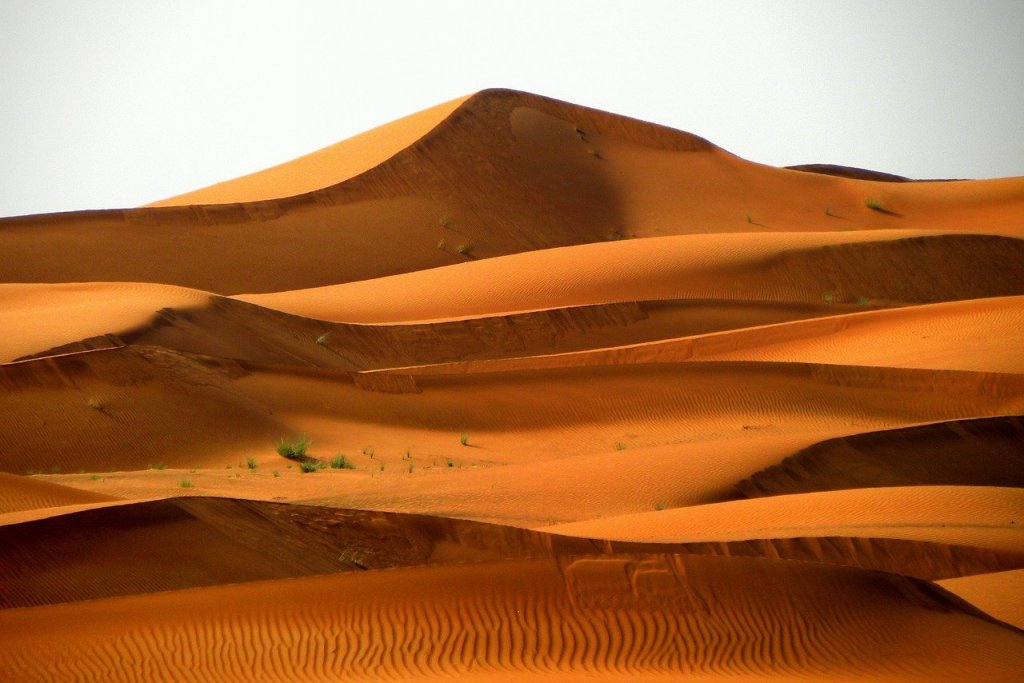
Despite being in an arid region, the Arabian Gulf’s proximity facilitated maritime trade routes and encouraged settlement. Over centuries, the shifting coastline and accumulation of sediment reshaped the city’s shoreline, enabling Dubai Creek to develop into a navigable waterway. While the emirate lacks natural rivers, the creek and various waterholes supported a modest yet sustainable human presence, anchoring the city’s formative years in seafaring and trade.
The local flora and fauna adapted to the harsh desert climate. Sturdy date palms and acacia trees provided shade and sustenance, while desert hyacinths and other hardy plants thrived in salty coastal soils. Wildlife like the Arabian oryx, desert foxes, and falcons have long symbolized resilience and survival against challenging environmental conditions. The ecosystem’s delicate balance offers a window into how people learned to utilize scarce resources efficiently.
Modern Dubai’s urban planning and environmental management reflect a desire to harmonize rapid growth with ecological stewardship. Initiatives include wildlife conservation areas, reforestation efforts, and marine reserves. Even as artificial islands and skyscrapers dominate headlines, the city is increasingly aware that sustainable development depends on respecting its natural inheritance. Striking a balance between economic growth and environmental responsibility remains an ongoing journey.
 Visit Dubai